M.A.R.E. Lecture Series 2026

#MAREMonday 45
02.03.2026, 20:00 CET (Central European Time)
Simon Moramarco
(Université Paul-Valéry de Montpellier)
Abstract:
At the end of the Second Punic War, the defeat of the Carthaginians allowed Rome to expand and establish a hegemonic position in the Mediterranean. The conquest of Hellenistic Greece from the 2nd century BCE gave generals and their armies the opportunity to plunder cities and sanctuaries (Corinth, Athens, etc.) and bring back spoils that included works of art and art craft objects, thus giving rise to a new trade: the «art market». By «works of art and art objects», we must understand finished products that were traded and whose main added value lay in specific craftsmanship and skills: an ars, which in ancient Rome pertained as much to art as to craftsmanship. The influx of spoils, transferred to Italy and displayed during triumphal ceremonies, revealed a strong taste for Greek art among members of the Roman aristocracy. The ever-growing appetite for these pieces among these elites did not stop at spoils, and commissions from the so-called «Neo-Attic» workshops, emerging between 170 and 160 BCE, increased, marking the birth of this new market.
During Antiquity, the most commonly used means of transportation remained navigation, whether by river or sea. The numerous submerged discoveries, made possible by the development of underwater and subaquatic archaeology, atest to the intensity of commercial traffic by waterway. On the coast of southern Gaul, several sites have revealed elements that we consider to be works of art or art craft objects. Protected from excessive human presence until the second half of the 20th century, coastal, lake, river, and underwater sites along this coast are now falling victim to it. This work aims to place them in their context by combining underwater archaeology, art history, and economic history.
#MAREMonday 44
02.02.2026, 20:00 CET (Central European Time)
Konstantinos Merkouris
(University of Patras)
Abstract:
The Mediterranean basin hosts a large number of underwater archaeological sites, the result of long-standing human activity along its coastal zones. These environments, favorable for early settlement and the development of trade, preserve valuable information about the historical trajectories of past societies. However, despite their considerable archaeological significance, shallow-submerged areas remain a “blind spot” between terrestrial and deep-water environments, as a clear and comprehensive methodological framework for their systematic documentation and study has yet to be established.
Recent technological advances have enabled underwater cultural heritage research to enter a new era, enabling the detailed recording of these complex environments and offering new possibilities by overcoming the difficulties and limitations of traditional methods of previous decades, reaching areas that are difficult or hazardous for human divers and research vessels.
Applied to the semi-submerged site of Grotta on Naxos, in Greece, this study introduces a new perspective on the documentation of shallow water sites through the use of a tailor-made robotic vessel equipped with integrated geophysical and optical sensors. The results of this work reveal that this adaptive approach enables multi-level data acquisition with high metrical accuracy and enhanced operational efficiency, offering a promising methodological direction for future shallow-water archaeological research across coastal sites.
#MAREMonday 43
12.01.2026, 20:00 CET (Central European Time)
M.A.R.E Organising Committee
Abstract:
To make the #MAREMonday Online Lecture Series more tangible, the organising committee decided to publish the proceedings of the project in form of a book. BAR Publishing, a prestigious publishing house, took on the project and now we can proudly present the volume: “Maritime Archaeology Research Exchange (M.A.R.E.) Papers from the 2021–2023 online lecture series”. Here, eight astonishing articles from the first three years of the online lecture series were collected. Covering a wide temporal and geographical range—from the Bronze Age to the Modern era and across the entire Mediterranean region, from the Pillars of Hercules to Alexandria, with a detour to the Black Sea. This volume is a comprehensive display of different methodological approaches, interdisciplinary work and various aspects of maritime archaeology research.
In this lecture, the editors will offer an inside look at the journey behind the publication— from the initial idea and the gathering of contributions to the challenges, developments, and successes that ultimately shaped the final book. In addition, several authors will introduce the research behind their chapters, providing an exclusive glimpse into the projects that give this volume its depth and character.
#MAREMonday 42
01.12.2025, 20:00 CET (Central European Time)
Juan del Caño Cobo
(University of Cyprus and Universidad de Sevilla)
Abstract:
Throughout the Iron Age, the Phoenician culture and identity played a major and influential role in Cyprus, coinciding with the development of the Cypriot City-Kingdoms. The case of Kition is particularly noteworthy for its strong connection with the Levant during the Cypro-Archaic and Cypro-Classical periods.
At the same time, the Iron Age represents a moment when the Mediterranean became “globalized” on multiple levels, establishing cultural connections between the Eastern and Western regions. One of the material categories that best illustrates this process of globalization is the development of the Phoenician Maritime Transport Containers, which, although already highly successful during the Late Bronze Age, gained even greater importance at this time through long-distance maritime exchange. Their role as containers specifically designed for ship transport was significantly enhanced, while their forms became increasingly standardized, even following distinct volumetric patterns depending on the market of destination.
The role of these vessels in Cyprus has been largely underestimated and understudied, appearing only tangentially in major reference publications. For this reason, the present study proposes an analysis based on the Phoenician Maritime Transport Containers excavated at Kition, focusing in particular on the review and examination of materials from the Archaic-period contexts of Kition-Kathari, and from the Classical-period contexts of the necropoleis of Agios Georgios, Agios Prodromos, and Pervolia, with the aim of defining the evolution of commercial contacts between Kition and the Levant.
#MAREMonday 41
03.11.2025, 20:00 CET (Central European Time)
Jaris Cole Darwin
(Leiden University)
Abstract:
The sea is a powerful, liminal space. Throughout time, it has always evoked anxiety while also offering opportunities; the use of this natural environment created groups of people, from seafarers and fishermen, to boatbuilders and merchants. This widespread association of cultural activities with the water led ancient religions in the Mediterranean to include some form of ritual connected to the sea. While Cyprus would have been no exception to this rule, dependent as the island was on overseas merchant enterprise, we have limited evidence for the maritime ritual activities of this region. One exception is the large assemblage of stone anchors found within the seaside religious complex of Kition Area II (Cyprus). These anchors are a unique and oft-mentioned example of possible Cypriot maritime rituality during the Late Bronze Age (LBA). However, the nature of this phenomenon—how these anchors may have functioned in a ritual setting—and its longevity is not well understood.
This lecture will re-evaluate the Kiton anchors using statistical and GIS analyses to offer a clearer picture of how and why anchors were used in such large quantities at Kition. The results of this work reveal a subset of cult which emphasized a maritime element, while also demonstrating ritual anchor use was chronologically limited to the 12th and 11th centuries B.C. This new exploration of anchors at Kition also better places them in a wider Mediterranean context and offers further evidence for Cypriot regionalism.
#MAREMonday 40
06.10.2025, 20:00 CET (Berlin Time)
Kaylie Aja Rogers
(University of Oxford)
The Total Institution and Navy Dog Mascots During the 20th Century
Abstract:
This study examines the significant role of dog mascots aboard naval vessels during the twentieth century through the lens of Goffman’s concept of total institutions. Analysis reveals that these mascots played a crucial role in maintaining crew welfare by fostering social connections, providing emotional comfort, and creating spaces of normalcy within the structured military environment.
Using photographic evidence and personal accounts, this study reveals how these animals may have helped bridge hierarchical divisions, provided legitimate outlets for emotional expression in hypermasculine environments, and contributed to crew morale and cohesion. The findings suggest that non-human actors can significantly modify and improve conditions within total institutions, adding to the discussion of non-human actors within institutional dynamics.
#MAREMonday 39
05.05.2025, 20:00 CET (Berlin Time)
Marco Freitas
(CEAM-Portugal)
Ponta de São Lourenço, the SS Newton and Madeira in the context of transatlantic routes during the 19th century, Portugal
Abstract:
The archaeological site of Ponta de São Lourenço is the easternmost location on Madeira Island, Portugal. With the work previously carried out at the site, it was possible to identify and record the archaeological context that is assumed to be that of the ship SS Newton, wrecked in 1881. The English ship was returning to its port of origin in Liverpool from Salvador da Baía in Brazil, carrying a cargo of around 1,200 tons of sugar and coffee. Its captain, miscalculating the route, rounded the point very close to the coast, running aground in the shallows, where it sank after a few days.
The archaeological study carried out provides interdisciplinary data for the construction of a historical narrative about the life of this ship, from its construction to the present day. Supported by this approach, Madeira Island was also analyzed as an important port of call on the great transatlantic routes, highlighting the Port of Funchal, with a subsequent approach to its function.
#MAREMonday 38
07.04.2025, 20:00 CET (Berlin Time)
Alberto Bravo-Morata Rodríguez
(Aix-Marseille University, Centre Camille Jullian)
The Phoenician Shipwreck of Xlendi, a Central Mediterrean exceptional shipwreck. From discovery to the latest results
Abstract:
Off the coasts of the Maltese archipelago, in the centre of the Mediterranean, the shipwreck of Xlendi was located in 2007 in a deep-water environment at -110m of depth. This site has been under study ever since its discovery, when the Phoenician Shipwreck Project was created, going through an initial remote sensing documentation campaign, a pioneer deep-water excavation with technical divers and a multidisciplinary post-excavation study period.
From University of Malta, a thorough study of the cargo has taken place since the extraction of the first objects, producing multiple documentations of them, including the experimentation of new techniques such as 3D laser scanning technology. This process, allowed replicating accurately all objects in 3D, ultimately allowing to reproduce the site as it is found on the seabed nowadays.
The amount of data generated in this project both on site and in the labs permitted the attempt of creating a method which could potentially estimate the total tonnage of the cargo of this Phoenician vessel. In addition, the geometric analysis of the site and the objects visible on the seabed allowed to bring up the hypothetical arrangement of this ensemble when it was intact. This communication will present the general outcome of the project, the results of the excavation campaigns, the post-excavation studies conducted in the past years, and finally, the results obtained from the creation of the method which attempted on replicating the cargo when still assembled and organized as well as the development process of the method itself.
#MAREMonday 37
03.03.2025, 20:00 CET (Berlin Time)
Francisco Mendes
(University of Lisbon, CHAM – NOVA FCSH)
Three-Dimensional Reconstruction in Nautical Archaeology – A team’s experience in Lisbon
Abstract:
In the last ten years the quantity of ships and boats hulls in the Portuguese archaeological record has considerably augmented, mainly due to construction work on the riverfront of Lisbon. At the same time, the technologies and methods available in the field have advanced at a considerable rate. We attempt here to give an overview of how these advances have contributed to our research by outlining our methods and the results we have been able to achieve in the different cases we have been working on.
#MAREMonday 36
03.02.2025, 20:00 CET (Berlin Time)
George Apeitos
(University of Oxford)
Names of Athenian Triremes: Investigating Group Cohesiveness and Social Identity in the Athenian navy of the 4th century BC
Abstract:
The set of inscriptions known as the Naval Inventories of Athens (IG II2 1604 – IG II2 1632) provide a wealth of information regarding the state of the Athenian navy in the 4th century BC. The inscriptions include the names of the triremes, of which 279 unique cases are preserved. This paper was developed around two questions: What kinds of names did Athenians choose for their warships? And is naming triremes a practice that goes beyond the practicality of keeping track of each ship?
Firstly, the historical background is presented, followed by a detailed investigation of triremes, both in technical characteristics and in the people comprising the crew. Furthermore, the triremes are described as complicated expressions of the society that built and used them, and hence, they are used as objects which lay the theoretical framework of this study. The names are presented in separated categories, resolving the first research question of this lecture. Theories of psychology and sociology are introduced, which helps to explain why naming warships is a tactic to enhance group cohesiveness. Sailors identify with the virtues and qualities of the ‘personified’ trireme, subconsciously developing their sense of belonging, improving their morale, confidence, and presumably overall performance, while fighting the world’s toughest frontier.
#MAREMonday 35
13.01.2025, 20:00 CET (Berlin Time)
Elisabetta Rosatti
(Università La Sapienza di Roma)
Reconstructing the Roman port system of Altinum: research approaches and some preliminary outcomes
Abstract:
Altinum was a Roman city in the Italian Northern Adriatic region, located near the ancient Venice Lagoon, along some key commercial routes between the Eastern Mediterranean and Central Europe. A natural and artificial waterways network with quays and warehouses bordered and crossed the city, connecting it with rivers, the Lagoon and the Adriatic. Therefore, Altinum was where various water-based trades converged, and it worked as a multiple scales and integrated port system.
This contribution will present the ongoing research project, which aims to clarify how this system worked by studying the port spaces, their “users” – goods and boats – and the mutual interaction between them. The presentation will outline the reasons and the ideas beyond this project, the objectives, and the main challenges encountered in the research. The focus will be on the investigations already conducted to reconstruct the port spaces, mainly archive research, a coring campaign, and a GIS project to manage and analyse the dataset. Eventually, this contribution will discuss some preliminary outcomes and mention future research perspectives.
M.A.R.E. Lecture Series 2024
#MAREMonday 34
02.12.2024, 20:00 CET (Berlin Time)
Jordy Moies
(Aix-Marseille University)
Assessing the In Situ Preservation of Underwater Archaeological Sites:
A GIS and Fieldwork-Based Approach
Abstract:
This presentation outlines a comprehensive approach to evaluating the preservation of underwater archaeological sites through both desk-based GIS analysis and targeted fieldwork. My PhD research focuses on how environmental processes—such as chemical corrosion, biological degradation, and physical erosion—impact the preservation of submerged sites. I will discuss a workflow designed to map and monitor these processes, combining open-access data with adapted fieldwork assessments to gauge preservation risks across different marine environments.
The project’s first phase involves GIS analysis to assess environmental stress factors and their spatial distribution, aiming to pinpoint areas where archaeological sites face heightened preservation challenges. The second phase involves data collection from similar shipwreck sites, which were subject to preservation assessments in the past, allowing for an environmental comparison and time-lapse monitoring.By adapting to available resources and project scope, this workflow can be applied to both single sites and regional projects worldwide.
#MAREMonday 33
04.11.2024, 20:00 CET (Berlin Time)
Olga Marinaki
(Universidad Complutense de Madrid)
Travelling between West and East,
a shipwreck with Roman Hispanic and African material off Kasos Island
Abstract:
In recent years, maritime archaeology in Greece has made significant progress in both the quality and quantity of the results obtained from underwater archaeological investigations in the Aegean. In the topic concerning ancient maritime trade, amphora shipwrecks are considered one of the most significant and reliable sources of information. Since the last publication of a catalogue of shipwrecks in Greek waters (around 100 by 2005/2006), systematic surveys have uncovered over 150 additional shipwrecks. Previously unrecorded overseas cargo shipwrecks from the central and western Mediterranean were recorded for the first time; a key example is the discovery of five shipwrecks with Roman African amphorae during the systematic investigation of the South Euboean Gulf. These discoveries have led to a series of preliminary publications that enriched our previous knowledge of the distribution of western amphorae cargoes in the Aegean. The extension of these efforts to the eastern Aegean through underwater surveys of remote islands such as that of Phournoi, which revealed more than 58 shipwrecks, provided new information on the character and the agents of maritime trade relations between the Aegean and the western Mediterranean during the Roman and late Roman period. A second such case concerns the systematic survey conducted in Kasos, which provided in 2020 the first Aegean evidence of a shipwreck with a main cargo of Afrikana IA and Dressel 20 type amphorae, otherwise the most widespread oil containers from the Iberian Peninsula in Roman times. The lecture aims to present the cargo of the wreck in relation to other known cases with relevant material, in an attempt to trace dots of exchange and trade networks between the East and the West in the Roman southeastern Aegean.
#MAREMonday 32
07.10.2024, 20:00 CET (Berlin Time)
Rebecca Xerri
(University of Malta)
A Journey to the Depths:
Making Deepwater Archaeology Accessible
Abstract:
This presentation will provide an overview of the researcher’s current doctoral research on the management and communication of deepwater archaeological parks. It shall delve into the concept of accessibility, referring to UNESCO’s insistence on public access to in situ cultural heritage within the Convention on the Protection of the Underwater Cultural Heritage (2001). In line with UNESCO’s aims, the presentation will detail some of the management and communication strategies that can be used for underwater archaeological parks. The data presented is based on comparative analyses into the world’s foremost archaeological parks and preserves and best-practice models for managing and communicating underwater cultural heritage resources. The researcher will home in on specifically deepwater archaeology, using the case study of the Xlendi Underwater Archaeological Park to illustrate some of the possibilities, as well as potential challenges, that come with opening a deepwater site to the public.
#MAREMonday 31
03.06.2024, 20:00 CET (Berlin Time)
Angela Falezza
(University of Oxford)
Mediterranean Ports Of Interactions:
Aegean And Southern Italy In The Late Bronze Age
Abstract:
The interactions between peoples across the Mediterranean have been much studied and debated both in relation to contemporaneous and ancient events, especially in light of their social implications. Ports are naturally an important gateway for interactions across the Mediterranean Sea. There are some port cities which have often been chosen as either temporary or final destination of these journeys made by sea, becoming place of gathering and interactions of different nature between cultures. This paper aims at investigating the role of ports of trade in the interactions between societies in Southern Italy and the Aegean, looking at whether their characteristics were unique to specific geographical areas or were widely shared across the Mediterranean. The sites selected as case study are located in different areas of the Mediterranean: Kommos on the Aegean Sea, Roca Vecchia on the Adriatic Sea, and Lipari on the Tyrrhenian Sea. The identification across different ports of interactions of some common patterns of behaviour suggests that similar dynamics of interactions were taking place between different cultures..
#MAREMonday 30
13.05.2024, 20:00 CET (Berlin Time)
Maria Michael & Crystal El Safadi
The review and evaluation of the latest experimental sailing with the Kerynia-Liberty
#MAREMonday 29
08.04.2024, 20:00 CET (Berlin Time)
Max MacDonald
(University of Southampton)
Harbours and Hinterlands: Experiencing the Sea in Mycenaean Messenia
Abstract:
Mycenaean Messenia is considered to be one of the core areas of the Mycenaean world in the Late Bronze Age Aegean. Although it is one of the most studied regions in Greece, there is little understanding of the relationship between the people who lived there and the sea. Much of the scholarly attention has been focused on trade and exchange, colonialism, and acculturation processes such as Minoanisation, and Mycenaeanisation, but there is an opportunity to move beyond these paradigms. Many theoretical approaches have been used to understand the interconnectivity of the Aegean and the different relationships with the sea. World-systems analysis and network analysis both intrinsically rely heavily on the sea for theorising connectivity, and seascapes, coastscapes and islandscapes, as well as maritime small worlds highlight the connections between coastal communities. Studies of the exchange of material culture and iconography as well as Linear B documents can offer further insight into the maritime world of the Aegean. These, however, do not fully engage with the sensorial and emotional presence of the sea in the landscape. This presentation explores the maritime world of Late Bronze Age Messenia through concepts within maritime archaeology which have not always had the same level of impact within the field of Aegean archaeology, but approaches such as maritime cultural landscapes, maritimity, and the phenomenology of the sea can bring a fresh perspective to the discipline. This research brings together, for the first time, Messenia’s maritime material culture for direct and indirect evidence of a relationship with the sea and the maritime world from across the region. It then undertakes computational, spatial, and visibility analyses to establish the presence of the sea in the landscape while reflecting on what the lived experience of the sea was like for the people living in Messenia during the Late Bronze Age. It highlights the need for a deeper understanding of Mycenaean lifeways and their perception of the environment.
#MAREMonday 28
04.03.2024, 20:00 CET (Berlin Time)
Vassilis Papadakis
(MoMArch Alumni)
Reassessment of ancient harbor-city of Asopos (mod. Plytra):
a semi-submerged city in Laconia, South Peloponnese, Greece
Abstract:
The remains of harbor-city installations near the modern settlement of Plytra in Laconia gulf, Xyli bay in southern Peloponnese, are dated in late Hellenistic and Roman period. They are associated with the ancient city of Asopos, a site of great archaeological importance as it was an essential trading post. This is evidenced by the size of the quarrying zones, the villa with mosaics, the multiple Roman baths, as well as the existence of a commercial harbor. Whereas, the Byzantine constructions are restricted parametrically of east bay. Ruins of the ancient city extends all along the entire length of the submerged wack bedrock, with the majority of them being located on the current spit formed coastline, presenting significant pathologies mainly due to the coastal erosion, formation processes and looting.
In order to contextualize the site, non-invasive investigations carried out, reveling more archeological remains and geomorphological indicators. This research aims to highlight the delimitation and interpretation of the port, the primary role in the development of the coastal configuration of the site through time played by the evolution of the relative sea level and the impact of tectonic events.
As the result of the aforementioned research, the sea basin in the east bay is considered the ancient harbor of the settlement. The creation of the mole, demarcating a sandy shore for the mooring and trading exchange of the vessels. Furthermore, the carved foundations of defensive structures at the southeast extremity of the old peninsula could be assessed for the possible re-evaluation of the paleo- shoreline. The frame outlined so far opens up new perspectives on the role of the Asopos in Hellenistic and roman times.
#MAREMonday 27
05.02.2024, 20:00 CET
Marta Del Mastro Ochoa
(Universidad de Alicante)
Mapping the sea: the spatial analysis of the marine spaces of the eastern peninsula through historical sources in the al-Ándalus era
Abstract:
The presentation that concerns us will focus on the development of a PhD thesis on going. This research is being conducted through the theoretical approach of the maritime cultural landscape, in the chronological scope of Al-Andalus and geographically focused in the southeast of the Iberian Peninsula. However, with our approach, we aim to lay a methodological set up which could be applicable to different geographical and chronological contexts.
As the title of the project suggests, the main objective of this study is to test the feasibility of using GIS to describe the maritime cultural landscape of a specific area and era, applying this methodology to the various case studies. Describing the maritime landscape will allow us to relate the environmental conditions of the coastal zone with the presence or absence of archaeological remains in several moments of time. Regarding the nautical perspective, we pretend to view the land from the sea, as
various aspects of the landscape will be analysed for their suitability to carry out activities related to the maritime environment, whether or not they involve directly the presence and use of vessels. As far as the diachronic perspective is concerned, underlying this premise is the fact that we are going to use not only several types of sources, in addition to the interdisciplinarity of this type of study, but also several chronological periods.
Regarding the method, we pretend to elaborate an „historical marine map“ which will consist of: theapproach to the interpretative reconstruction of the paleo-coast through studies of coastal geomorphology, followed by the reinterpretation of historical sources from a nautical perspective, the identification of elements of the maritime cultural landscape and their functions, whose data will be structured in a relational database, and the creation of a GIS platform through which we will conduct several analyses on the proposed landscape. Some of the analysis proposed will consist of the superimposition of historical cartography, reconstruction of marine spaces when possible as well as the paleo coast, and the geolocation of the elements as individual entities and performance of various statistical analyses.
#MAREMonday 26
08.01.2024, 20:00 CET
Nireas Markakis
(Aix-Marseille University)
Maritime commerce, naval supremacy and piracy in the Peloponnese-Crete strait: the island of Kythera. A geoarchaeological assessment
Abstract:
The island of Kythera is located upon one of the most dangerous passages, of one of the most important maritime routes of the Mediterranean. Subsequently, the island’s geostrategic value was exploited for commercial, military, and paramilitary purposes by various agents throughout its known history.
The island has been the subject of research mostly focusing on terrestrial sites and specific periods. Generally accepted as a prominent hunting zone, pirate activity in the waters of Kythera is well attested during the modern period but remains mostly inferred during antiquity. Additionally, the operational specifics determining pirate activity in the region remain unclear.
In order to investigate pirate activity in Kythera across time, and delineate the modus operandi of attacks at sea, this study utilizes a synthetic geo-archaeological approach – namely the investigation of the fundamental geomorphological parameters and technological constraints defining navigation in the region, in order to define specific potent zones of operation off the island’s coasts, and the subsequent re-assessment of associated archaeological sites corresponding to periods of increased pirate activity in the region.
This article is part of a wider, ongoing, geo-archaeological GIS-based assessment of the island’s maritime history. It utilizes textual and iconographical sources, as well as current geomorphological, historical, and archaeological research. This corpus is complemented by historical cartography, cross-examined with present-day data, reports from local seamen recently interviewed, and field observations.
M.A.R.E. Lecture Series 2023

#MAREMonday 25
04.12.2023, 20:00 CET
Mohamed Abdelaziz
(Ministry of Tourism and Antiquities, Alexandria Department of Antiquities, Research Associate at CEAlex / UAR 3134 CNRS)
Revealing underwater 3D hidden Archaeological inscriptions in Alexandria, Egypt: Mixed techniques between Photogrammetry and Virtual reflectance transformation imaging
Abstract:
In Alexandria-Egypt, CEAlex (Centre d’etudes Alexandrines) conducted the first scientific underwater excavations in 1994 on the submerged site of the remains of the ancient lighthouse of Alexandria near Qaitbey fort, since 2014, for the first time in Egypt, with the support of Honor Frost foundation, the center has launched a 3D underwater photogrammetry data-gathering program to obtain a DSM – Digital Surface Model – of the submerged site of the lighthouse, and a 3D model of some artifacts. During this work, many challenges were inherent all over the processing methods to make the result more efficient. For this reason, Photogrammetry and computer graphics may be used to help discover and encode accurate optical properties of materials, such as inscriptions and features of small objects. In this paper we present the result of an underwater research project using mixed techniques between photogrammetry and ’Virtual’’ Reflection Transformation Imaging (RTI) combine with Photogrammetry of a statue base locate underwater, achieved by applying ‘’Virtual’’ lighting to 3D model objects, using multiple images of fixed view-points and varying lighting conditions, these techniques allow virtual automated reconstruction of highly detailed 3D texture-mapped models, to show all visible inscriptions and hidden details of the object using some specific filter and altering the light in RTI after stripping any color and texture information from it, we describe the V-RTI method and critically compare it to the current standard Highlight (H-RTI) method.
#MAREMonday 24
06.11.2023, 20:00 CET
Julia Zerafa
(University of Malta)
#MAREMonday 23
02.10.2023, 20:00 CET
Kato Nees
(Aix-Marseille University)
#MAREMonday 22
01.05.2023, 20:00 CET
Asmaa Fayed
(Alexandria Center for Maritime Archaeology and Underwater Cultural Heritage,
Alexandria University)
Management of beached and intertidal shipwreck
#MAREMonday 21
03.04.2023, 20:00 CET
Soledad Solana Rubio
(Universidad de Cádiz)
#MAREMonday 20
06.03.2023, 20:00 CET
Sara Macke
(Department of Maritime Civilizations, University of Haifa, Haifa, Israel)
#MAREMonday 19
06.02.2023, 20:00 CET
Dimitra Voutyrea,
(Korseai Institute. Institute of Historical & Archaeological Research)
#MAREMonday 18
16.01.2023, 20:00 CET
Georgia-Dimitra Kyriakou
(Department of History and Archaeology – University of Cyprus)
#MAREMonday 17
05.12.2022, 20:00 CET
Katharina Zerzeropulos
(ROOTS Cluster of Excellence – CAU Kiel)
A space syntax approach to Ostia’s port
#MAREMonday 16
07.11.2022, 20:30 CET
Judith Gatt
(Aix-Marseille University (Centre Camille Jullian) and University of Cyprus; Honor Frost Foundation scholar; Eurocean Youth Ambassador-Surfrider Foundation Europe)
#MAREMonday 15
03.10.2022, 20:00 CET
Ada Lasheras González
(École des Hautes Études Hispaniques et Ibériques – Casa de Velázquez / Institut Català d’Arqueologia Clàssica)
Understanding the Roman Port of Tarraco through Urban Archaeology
#MAREMonday 14
02.05.2022, 20:00 CET
Felix Reize
(Universität zu Köln)
Deciphering Ampurias‘ past – a contribution from the geoarchaeological perspective.
Join the Facebook Event here
#MAREMonday 13
04.04.2022, 20:00 CET
Noran Hamed
(University of Southampton)
Join the Facebook Event here
#MAREMonday 12
07.03.2022, 20:00 CET
Dzhem Habil
(Freie Universität Berlin)
Join the Facebook Event here
#MAREMonday 11
07.02.2022, 20:00 CET
Angiolo Querci
Koan Painted Medium-Coarse Pottery and the “SASCAR String”: Towards a Navigation Model for the Aegean Late Bronze Age
Join the Facebook Event here.
#MAREMonday 10
10.01.2022, 20:00 CET
Pascal Arnaud
(Professeur émérite – Université Lumière-Lyon 2)
Towards a typology of ancient ports
#MAREMonday 09
06.12.2021, 20:00 CET
Cristina Laurenti
(University of Oxford)
#MAREMonday 08
01.11.2021, 20:00 CET
Mieke Kassulke
(University of Malta)
Liquid Melody: An Archaeology of Sirens, Mythology and Maritime Navigation in the Greco-Roman World
#MAREMonday 07
05.07.2021, 20:00 CET
Max Fiederling
(Ludwig-Maximilians-Universität München)
From Discovery to Display – Concept of an Interdisciplinary Exhibition
https://www.facebook.com/events/340775201002266
#MAREMonday 06
07.06.2021, 20:00 CET
Chiara Maria Mauro
(Universidad Complutense de Madrid)
https://www.facebook.com/events/392356865253561/
#MAREMonday 05
03.05.2021, 20:00 CET
Pascal Hoffmann
(Universität Heidelberg)
Diseases and Health Risks of Roman Sailors.
https://www.facebook.com/events/1203060066815804
#MAREMonday 04
12.04.2021, 20:00 CET
Michaela Reinfeld
(Römisch-Germanische Kommission)
A villa with two harbours? The Roman villa maritima on the Cape of Sorrento.
https://www.facebook.com/events/423558202064657
#MAREMonday 03
01.03.2021, 20:00 CET
Marie Pawlowicz
(Aix-Marseille Université)
https://www.facebook.com/events/2865484523716999
#MAREMonday 02
01.02.2021, 20:00 CET
Jafar Anbar
(Aix-Marseille Université)
https://www.facebook.com/events/1229542414108609
#MAREMonday 01
11.01.2021, 20:OO CET
Jose-Oscar Encuentra Bardina
(Centre for Maritime Archaeology, University of Southampton)
https://www.facebook.com/events/791654658231958/
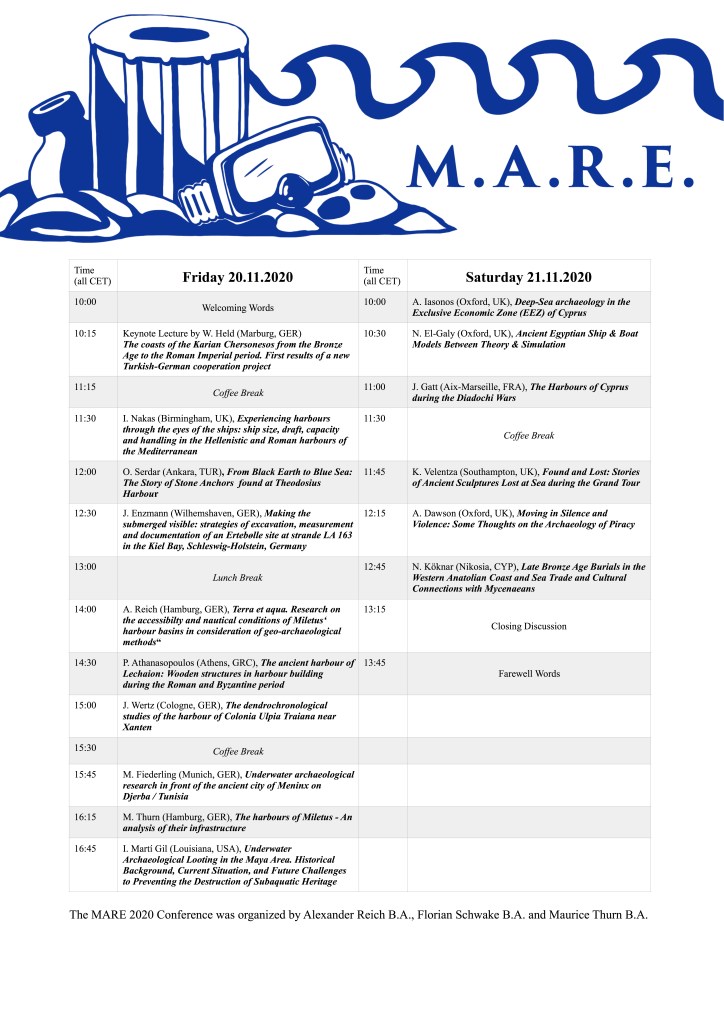
MARE Conference 2020
You can download the book of abstract for the MARE Conference 2020 here
 MARE - Online Lecture Series